
Projection Domes for 360° Immersive Events and Brand Experiences
Plan a geodesic projection dome around the audience, content, venue and viewing conditions—not just the shell. DomeGuys helps turn projection mapping, live feeds, branding and architectural lighting into a shared visual environment.
What is a projection dome?
A projection dome is a geodesic structure configured as a shared visual environment. Projected imagery, lighting or both can use the dome’s interior surface, triangular frame geometry or an added flat screen. The right structure, cover, projection surface, equipment and content workflow depend on audience position, ambient light, venue conditions and the experience you want to create.
Audience-first
Unlike headsets, a dome lets a group experience the same visual story together. Capacity and sightlines should shape the diameter, layout and viewing orientation.
Surface-first
Translucent and opaque covers behave differently. Decide whether imagery, architectural lighting or both must be visible from the interior, exterior or around the clock.
Content-first
Projection mapping, live feeds, branded sequences and conventional screen content require different media preparation, playback and technical scopes.
Video mapping, lighting or a hybrid approach
The current DomeGuys projection offering supports two core approaches. They can stand alone or be combined in a project-specific system.
Video projection mapping
Video mapping within the geodesic framework allows graphic configurations to use individual triangular facets as part of a larger composition. Multiple carefully mapped projectors can stretch imagery across the interior surface and deliver prepared sequences, a live feed or branded content.
Plan for: content format, media-server and playback responsibility, projector positions, overlap and blending, audience sightlines, resolution, audio, calibration and operator requirements.
Standard lighting projection
Lighting placed in, on and around the dome can rapidly change the atmosphere of a venue. A translucent cover can reveal lighting from both inside and outside. An opaque projection dome can reduce daylight intrusion for internal projections, and a flat projection screen can be added for conventional interactive media.
Plan for: desired interior/exterior visibility, cover choice, ambient light, fixture locations, power distribution, control system, rigging and weather protection.
| Approach | Best when | Critical decisions | Ask in the quote |
|---|---|---|---|
| Mapped dome imagery | You want content to follow the geodesic facets or span the interior | Content template, projector count and positions, blending, playback | Who supplies mapping, equipment, content preparation and operation? |
| Architectural lighting | Color, movement and atmosphere matter more than continuous video | Cover translucency, fixture placement, control, power and weather | Which lighting and control elements are included versus client supplied? |
| Flat screen inside a dome | Conventional video must remain legible while the dome frames the space | Screen size, throw distance, seating, ambient light and access | How does the screen interact with the dome layout and egress? |
| Hybrid system | You need mapped visuals, lighting and a presentation surface | One coordinated technical plan, power load and show control | Who owns integration, testing, rehearsals and on-site troubleshooting? |
Projection mapping and lighting treatments
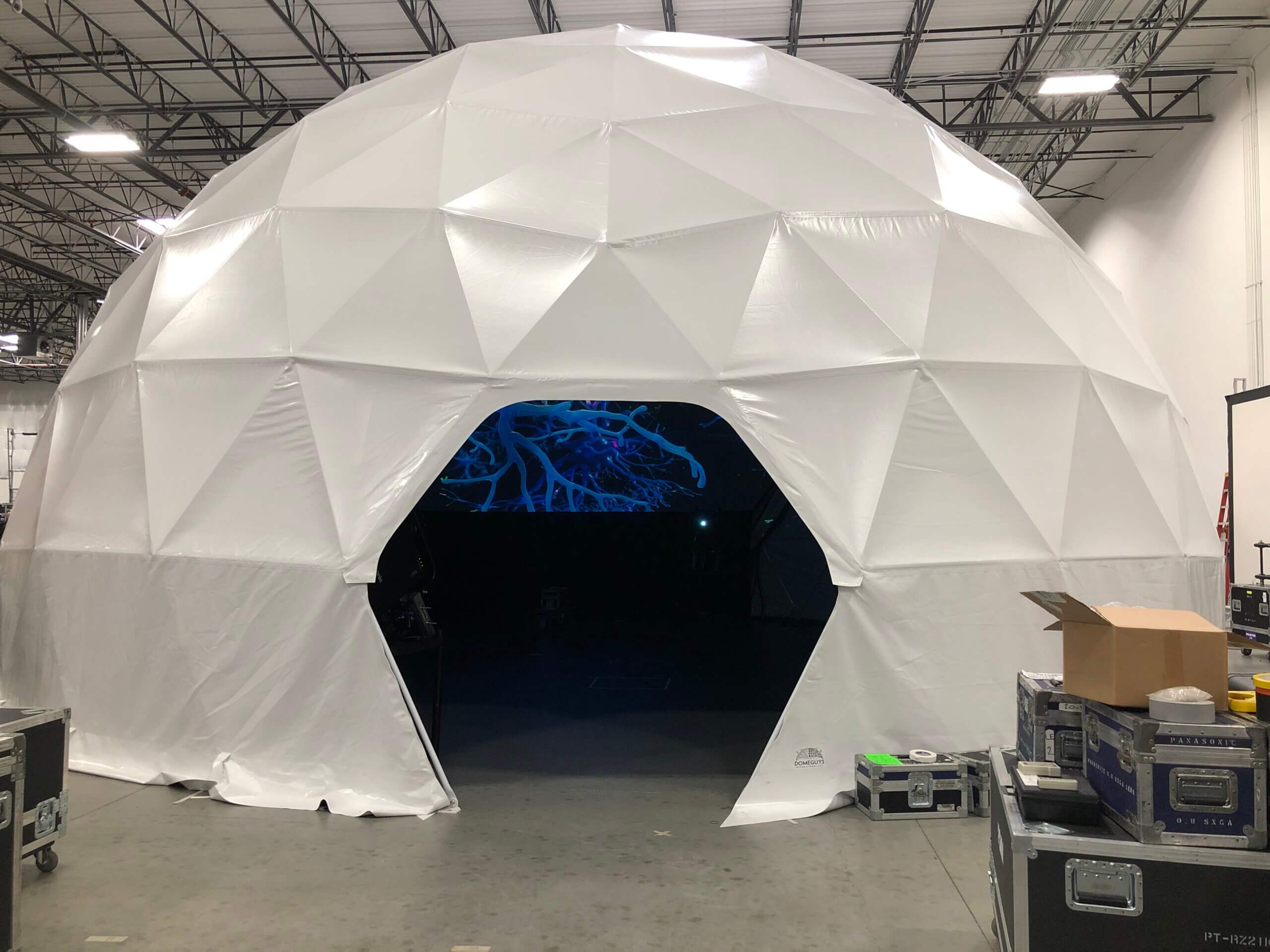


See the existing DomeGuys projection example in motion.
Plan the complete projection environment
A useful quote starts with the experience and constraints. These inputs affect the dome, projection surface, technical scope, installation and total project cost.
A practical projection dome workflow
Define
Share the date, location, audience, visual goal, content status and available technical resources.
Configure
Coordinate dome size, cover or screen strategy, openings, equipment positions and required options.
Integrate
Confirm content template, playback, projection, lighting, audio, power and responsibility boundaries.
Install and test
Allow time for structure assembly, equipment setup, mapping, focus, rehearsals and final show checks.
Project scope and availability vary. A DomeGuys quote should identify what is included, what the client or AV partner supplies, and the assumptions behind installation and operation.
Related DomeGuys resources
Projection dome FAQs
Can a projection dome work during daylight?
It depends on the cover and visual approach. DomeGuys’ existing guidance notes that an opaque dome can block daylight for internal projection, while a translucent cover is useful when lighting should be visible from inside and outside. Venue light leakage, openings and projector output still need to be evaluated.
How many projectors does a 360 projection dome need?
There is no universal count. Diameter, projection surface, resolution, viewing coverage, projector model, lens choice, overlap, brightness and content design all matter. Ask the projection integrator to specify coverage and blending for the chosen dome.
Can a projection dome show live video or branded content?
Yes. The existing DomeGuys page identifies live feeds, selected projections and branding as possible uses. The media-server, signal path, content preparation and operator scope should be confirmed before the event.
Is projection equipment included with the dome?
Do not assume it is. Request an itemized quote that states whether the structure, cover or screen, projectors, lenses, playback, lighting, audio, cabling, labor, content work and show operation are included or supplied by others.
Should I choose a translucent or opaque projection dome?
Choose based on where the effect must be visible and how much ambient light must be controlled. Translucent material can reveal lighting on both sides. Opaque material is typically the stronger starting point for internal projection where daylight control matters.
What information is needed to price a projection dome?
Provide the location and dates, audience and layout, desired diameter, indoor or outdoor use, visual objective, cover preference, content and equipment scope, power, access, setup window, anchoring, flooring, HVAC and installation responsibilities.
Turn your visual concept into a quote-ready projection dome plan.
Share the venue, dates, audience, experience, content and technical scope. DomeGuys can help define the structure and project-specific options.